|
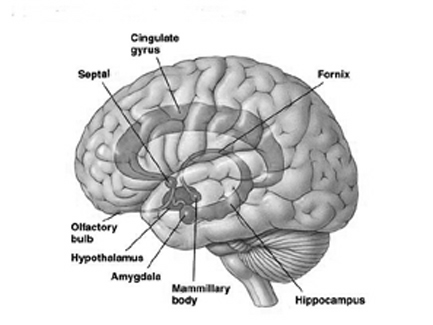
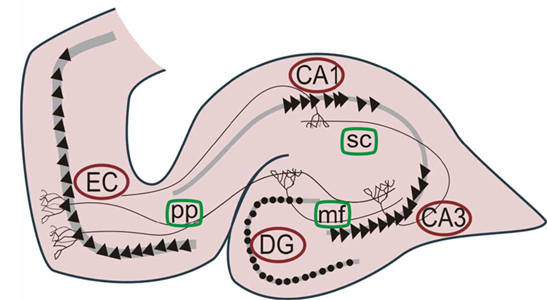
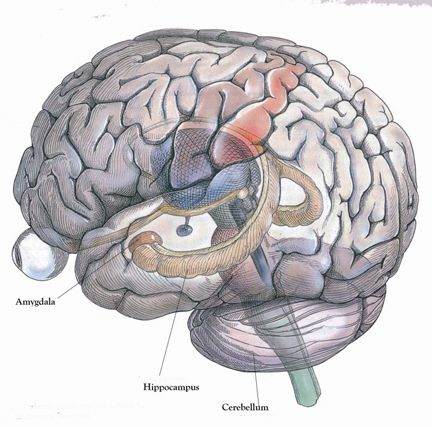
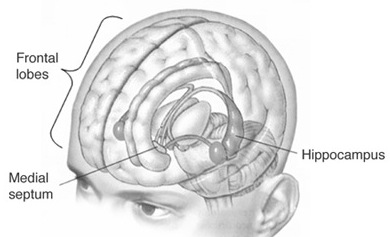
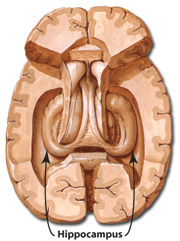
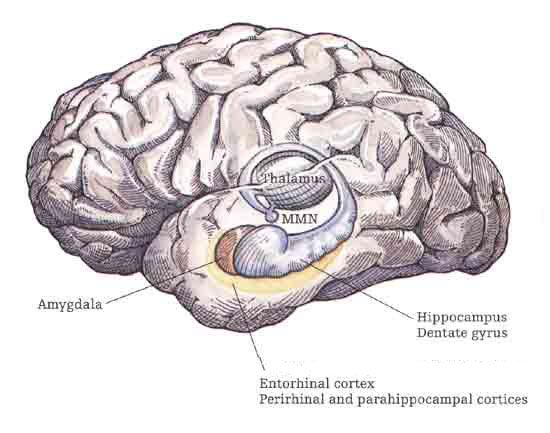
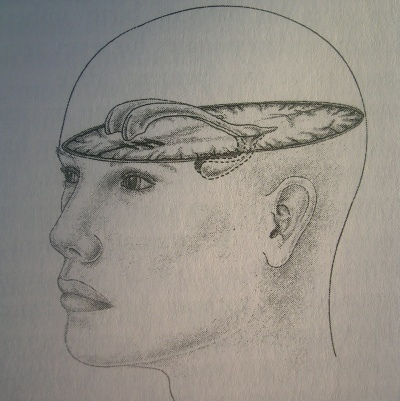
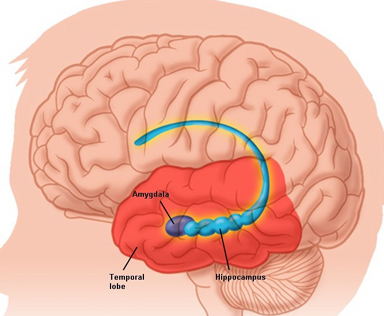
HIPPOCAMPUS The hippocampus (Ammon's Horn" or the "sea horse") is an elongated structure located within the inferior medial wall of the temporal lobe (posterior to the amygdala) and surrounds, in part, the lateral ventricle. In humans it consists of an anterior and posterior region and depending on the angle at which it is viewed, could be construed as shaped somewhat like an old fashion telephone receiver, or a "sea horse." The hippocampus consists of a number of subcomponents, and adjoining structures, such as the parahippocampal gyrus, entorhinal and perirhinal cortex and the uncus (which it shares with the amygdala) are considered by some to be subdivisions, whereas the main body of the hippocampus consists of the dentate gyrus, the subiculum, and sectors referred to as CA1, CA2, CA3, CA4.Memory & Attention
The uncus is a bulbar allocortical protrusion located in the anterior-inferior medial part of the temporal lobe, and consists of both the hippocampus and amygdala which become fused in forming this structure. That is the ventral-medial portion of the amygdala becomes fused with the head of the hippocampus, such that the uncus consists of both allocortex and mesocortex--the entorhinal cortex which shrouds the hippocampus.
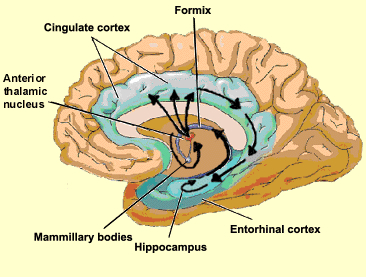
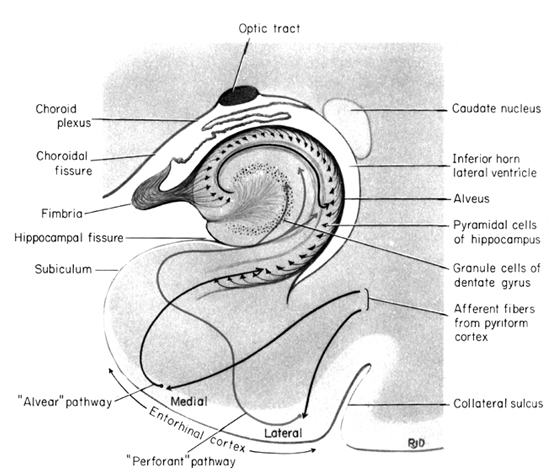
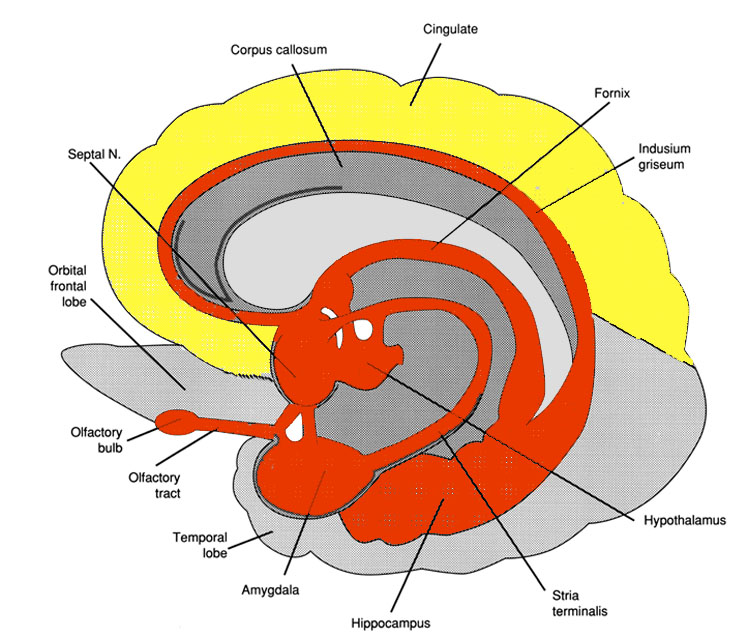
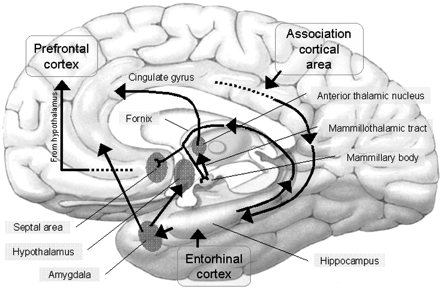
There are three major neural pathways leading to and from the hippocampus. These include the fornix-fimbrial fiber system, a supracallosal pathway (i.e. the indusium griseum) which passes through the cingulate, and via the entorhinal area--the mesocortical gateway to the hippocampus. It is through the fornix-fimbrial pathways that the hippocampus makes major interconnections with the thalamus, septal nuclei, medial hypothalamus, and via which it exerts either inhibitory or excitatory influences on these nuclei (Feldman et al. 1987; Guillary, 1957; Poletti & Sujatanon, 1980; Risvold & Swanson, 1996).
Essentially, the fornix and fimbria are one and the same, as the fornix becomes the fimbria as they arch together near the tail of the hippocampus, with the fornix continuing its journey jutting beneath the corpus callosum where it meets the contralateral fornix from the contralateral tail of the hippocampus. It is at this junction that the fornix distributes massive axonal fibers to the medially located septal nuclei (the septum pellucidum).
Thus, the hippocampus maintains a particularly intimate relationship with the septal nuclei via the fornix, such that the tail of the hippocampus is directly connected with the septal nuclei which then relays hippocampal impulses to the hypothalamus (and back again); which in turn may enable these structures to form conjunctions between those external events which are memorable with internal homeostatic events which preceded, coincided, or followed. The septal nucleus partly serves as in interactional relay center as it channels hippocampal influences to other structures such as the hypothalamus and reticular formation (and vice versa) and as a major link through which the hippocampus and amygdala sometimes interact (Gloor, 1997; Hagino & Yamaoka, 1976).
The entorhinal cortex acts to relays information to and from the hippocampus. It is through the entorhinal cortex that the hippocampus maintains interconnections with the neocortical multi-modal associations areas of the temporal, frontal, and parietal lobes, including surrounding structures, e.g., the parahippocampal gyrus, and allocortical tissues, the perirhinal cortex, septal nuclei and amygdala (Amaral et al. 1992; Carlsen et al. 1982; Gloor, 1955; Krettek & Price, 1976; Murray 1992; Steward, 1977; Van Hoesen et al. 1972). The parahippocampal gyrus, entorhinal and perirhinal cortex, being directly interconnected with the hippocampus and the neocortex, act to relay input from the neocortical association areas to this structure. In fact, they interact so intimately with the hippocampus that some investigators considered them as part of the "hippocampal system." The "hippocampal system" however, is considerd by some to also include the amygdala, dorsal medial nucleus, the septal nuclei, and the hypothalamus and brainstem. Hence, when considered broadly, the "hippocampal" system could be viewed as forming a unified substrate that subserves the non-motor aspects and declarative aspects of memory (Gloor, 1997).
The entorhinal cortex, particular, is a major component of the "hippocampal system." This structure is truly unique, not only because it serves as an interface between the hippocampus and the neocortex, but because this medial located structures consists of between 7 and 8 layers (Braak & Braak, 1992; Ramon y Cajal, 1902/1955; Rose, 1926). The entorhinal cortex also maintains massive interconnections with all multi-modal neocortical association areas (as well as with the amygdala, hippocampus, septal nuclei, olfactory bulb, etc.) but apparently none of the primary sensory areas (Leichnetz & Astruc, 1976; van Hoesen, et al., 1975). Hence, the entorhinal cortex must play a supramodal role that is exceedingly unique and profoundly important in memory and cognitive processing. However, as to its exact role is difficult to determine, as it is difficult, if not impossible to cut away the entorhinal cortex from the hippocampus without damaging or deinnervating both. Nevertheless, presumably they subserve different aspects of memory.
As noted, the amygdala, septal nuclei, as well as the parahippocampal gyrus also maintains direct interconnections with the hippocampus as well as with each other and often overlapping neocortical areas, such as the orbital frontal lobe. The hippocampus is greatly influenced by the amygdala which in turn monitors and respondes to hippocampal activity (Gloor, 1955, 1992, 1997; Green & Adey, 1956; Halgren 1992; Steriade, 1964). Indeed, the amygdala may act to alert the hippocampus to stimuli or events which are emotionally significant so that the hippocampus "pays attention" and stores the non-emotional attributes in memory. The amygdala also acts to relay certain forms of information from the hippocampus to the hypothalamus (Poletti & Sajatanon, 1980), thus forming an emotional-cognitive circuit which may enable the organism to relate external events to internal events, and to then store this integrated information in memory; for example a particular tasty food items (or prey) that was discovered in a certain spatial location. The hippocampus and amygdala thus interact in regard to attention, the generation of emotional and other types of imagery, as well as learning and memory.
Since the amygdala becomes fused with the head of the hippocampus, and as they also interact via the entorhinal cortex, it is difficult, if not impossible to cut away one structure from the other without damaging or deinnervating both. Hence, those studies which claim to remove the amygdala while sparing the hippocampus, or vice versa, and/or to have removed these structures while sparing the entorhinal cortex, and the claims made by these investigators regarding the results of these studies, must be viewed with a measure of skepticism (see Gloor, 1997, for related discussion).
Nevertheless, it was reported by Scoville and Milner (1957), in their classic paper which revolutionized thinking as to the role of the hippocampus in memory, that although the surgical destruction of the hippocampus and amygdala (plus the uncus and parahippocampal gyrus) resulted in profound amnesic syndrome, that similar deficits were not observed when just the uncus, the amygdala, and head of the hippocampus were removed. On the other hand, these tissues were removed because they were abnormal, and as the amygdala is often the source of temporal lobe seizures (Gloor, 1997), including even seizure-induced damage to the hippocampus, the findings of Scoville and Milner (1957) and Penfield and Milner (1958), and all related papers regarding the removal of damage tissue, must be viewed with caution as they may not be generalizable to the normal amygdala and hippocampus. Due to neuroplasticity other structures may have taken over the "normal" functions of the amygdala, such that in consequence, there is no memory loss as those aspects of memory associated with the the amygdala are now subserved by another region of the brain. Indeed, there is no general consensus as to the role of the hippocampus (or the amygdala) in memory, and the interested reader is directed to the special issues of the journal, Hippocampus (Vol. 1, #3) and the Journal of Cognitive Neuroscience (Vol. 4, # 3), where various protagonists lay out their differing views.
HIPPOCAMPAL AROUSAL, ATTENTION & INHIBITORY INFLUENCES
Various authors have assigned the hippocampus a major role in information processing, including memory, new learning, cognitive mapping of the environment, voluntary movement toward a goal, as well as attention, behavioral arousal, and orienting reactions (Douglas, 1967; Eichenbaum et al. 1994; Enbert & Bonhoeffer, 1999; Frisk & Milner, 1990; Grastayan et al., 1959; Green & Arduini, 1954; Isaacson, 1982; Milner, 1966, 1970, 1971; Nishitani, et al., 1999; Olton et al. 1978; Routtenberg, 1968; Squire, 1992; Victor & Agamanolis, 1990; Xu et al., 1998). For example, hippocampal cells greatly alter their activity in response to certain spatial correlates, particularly as an animal moves about in its environment (Nadel, 1991; O'Keefe, 1976; Olton et al., 1978; Wilson & McNaughton, 1993). It also developes slow wave theta activity during arousal (Green & Arduini, 1954) or when presented with noxious or novel stimuli (Adey et al.1960)--at least in non-humans.
However, few studies have implicated this nucleus as important in emotional functioning per se, although responses such as "anxiety" or "bewilderment" have been observed when directly electrically stimulated (Kaada et al. 1953). Indeed, in response to persistent and repeated instances of stress and unpleasant emotional arousal, the hippocampus appears to cease to participate in cognitive, emotional, or memory processing (chapter 30). Thus the role of the hippocampus in emotion is quite minimal.
AROUSAL
Hippocampal-neocortical interactions. Desynchronization of the cortical EEG is associated with high levels of arousal and information input. As the level of input increases, the greater is the level of cortical arousal (Como et al. 1979; Joseph et al. 1981; Joseph, 1998b, 1999d). However, when arousal levels become too great, efficienty in information processing, memory, new learning, and attention become compromised as the brain becomes overwhelmed (Joseph, 1998b, 1999d; Joseph et al., 1981; Lupien & McEwen, 1997; Sapolsky, 1996).
When the neocortex becomes desynchronised (indicating cortical arousal), the hippocampus often (but not always) developes slow wave theta activity (Grastyan et al., 1959; Green & Arduni, 1954) such that it appears to be functioning at a much lower level of arousal--as demonstrated in non-humans. Conversely, when cortical arousal is reduced to a low level (indicated by EEG synchrony), the hippocampal EEG often becomes desynchronized.
These findings suggest when the neocortex is highly stimulated the hippocampus, in order to monitor what is being received and processed, functions at a level much lower in order not to become overwhelmed. When the neocortex is not highly aroused, the hippocampus presumably compensates by increasing its own level of arousal so as to tune in to information that is being processed at a low level of intensity.
Hence, in situations where both the cortex and the hippocampus become desynchronized, there results distractability and hyperresponsiveness such that the subject becomes overwhelmed, confused, and may orient to and approach several stimuli (Grastyan et al., 1959). Attention, learning, and memory functioning are decreased. Situations such as this sometimes also occur when individuals are highly anxious or repetitively emotionally or physically traumatized (see chapter 30).
The hippocampus consists of 3 layers, layer 2 consisting of pyramidal neurons which provide excitatory output and thus act to activate and arouse target tissues; via the transmitters glutamate and aspartic acid. In addition, the entorhinal cortex provides excitatory input into the hippocampus--input which is derived from the neocortex; using again, aspartic and glutamate acid (reviewed in Gloor, 1997). Specifically, it appears that the hippocampus interacts with the neocortex is regard to arousal via the dorsal medial nucleus of the thalamus, the septal nuclei, the hypothalamus, amygdala and brainstem--structures with which it maintains direct interconnections. As per the neocortex, this sheet of tissue is also innervated by these structures, and by the entorhinal cortex.
Hence, the hippocampus serves as a major component of an excitatory interface and can be aroused by neocortical activity (via the entorhinal cortex), and can provide excitatory input to directly to subcortical structures and indirectly to the neocortex (via the entorhinal cortex and dorsal medial nucleus). However, if the neocortex becomes excessively aroused, so to might the hippocampus, and vice versa. Under excessively arousing conditions, however, hippocampal pyramidal neurons may become inhibited or even damaged (Lupien & McEwen, 1997; Sapolsky, 1996), thus resulting in loss of memory.
There is also evidence to suggest that the hippocampus may act so as to reduce extremes in cortical arousal. For example, whereas stimulation of the reticular activating system augments cortical arousal and EEG evoked potentials, hippocampal stimulation reduces or inhibits these potentials such that cortical responsiveness and arousal is dampened (Feldman, 1962; Redding, 1967). On the otherhard, if cortical arousal is at a low level, hippocampal stimulation often results in an augmentation of the cortical evoked potential (Redding, 1967).
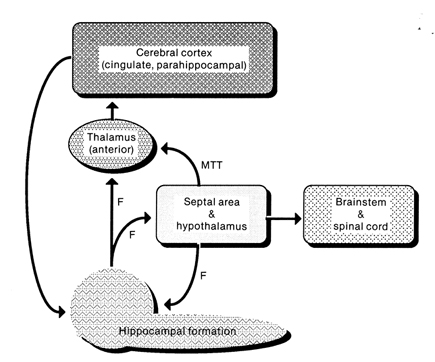
The hippocampus also exerts desynchronizing or synchronizing influences on various thalamic nuclei (e.g., the dorsal medial thalamus) which in turn augments or decreases activity in this region (Green & Adey, 1956; Guillary, 1955; Nauta, 1956, 1958). As the dorsal medial thalamus is the major relay nucleus to the neocortex, the hippocampus therefore appears able to block or enhance information transfer to various neocortical areas (that is, in conjunction with the frontal lobe, see chapter 19). Indeed, it may be acting to insure that certain percepts are stored in memory at the level of the neocortex (Gloor, 1997; Squire 1992) by modulating cortical activity.
It is thus likely that the hippocampus may act to influence information reception and storage at the neocortical level as well as possibly reduce extremes in cortical arousal (be they too low or high) perhaps by activating inhibitory circuits in the dorsal medial nucleus, thus ensuring that the neocortex is not over or underwhelmed when engaged in the reception and processing of information. This is an important attribute since very high or very low states of excitation are incompatible with alertness and selective attention as well as the ability to learn and retain information (Joseph et al. 1981; Lupien & McEwen, 1997; Sapolsky, 1996).
Aversion & Punishment.
In many ways, the hippocampus appears to act in concert with the medial hypothalamus and septal nuclei (with which it maintains rich interconnections) so as to also prevent extremes in emotional arousal and thus maintain a state of quiet alertness (or quiescence). Moreover, similar to the results following stimulation of the medial hypothalamus, it has been reported that the subjective components of aversive emotion in humans is correlated with electrophysiological alternations in the hippocampus and septal area (Heath, 1976).
The hippocampus also appears to be heavily involved in the modulation of reactions to frustrations or mild punishment (Gray, 1970, 1990), particularly in regard to single trial but not multiple trial learning. For example, the hippocampus responds with trains of slow theta waves when presented with noxious stimuli but habituates or ceases to respond with repeated presentation. It is likely, however, that these physiological responses are secondary to activity within the amygdala and hypothalamus which then effects hippocampal functioning.
ATTENTION & INHIBITION
The hippocampus participates in the elicitation of orienting reactions and the maintainance of an aroused state of attention (Foreman & Stevens, 1987; Grastayan et al., 1959; Green & Arduini, 1954; Nishitani, et al., 1999; Routtenberg, 1968). When exposed to novel stimuli or when engaged in active searching of the environment, hippocampal theta appears (Adey, et al. 1960). However, with repeated presentations of a novel stimulus the hippocampus habituates and theta disappears (Adey et al. 1960). Thus, as information is attended to, recognized, and presumably learned and/or stored in memory, hippocampal participation diminishes. Theta also appears during the early stages of learning as well as when engaged in selective attention and the making of discriminant responses (Grastyan et al. 1959).
When the hippocampus is damaged or destroyed, animals have great difficulty inhibiting behavioral responsiveness or shifting attention. For example, Clark and Issacson (1965) found that animals with hippocampal lesions could not learn to wait 20 seconds between bar presses if first trained to respond to a continous schedule. There is an inability to switch from a continous to a discontinous pattern, such that a marked degree of perseveration and inability to change sets or inhibit a pattern of behavior once initiated occurs (Douglas, 1967; Ellen, et al. 1964). Habituation is largely abolished and the ability to think or respond divergently is disrupted. Disinhibition due to hippocampal damage can even prevent the learning of a passive avoidance task, such as simple ceasing to move (Kimura, 1958).
Hence, when coupled with the evidence presented above, it appears that the hippocampus acts to possibly selectively enhance or diminish areas of neural excitation which in turn allows for differential selective attention and differential responding, as well as the storage and consolidation of information into long term memory. When damaged, the ability to shift from one set of perceptions to another, or to change behavioral patterns is disrupted and the organism becomes overwhelmed by a particular mode of input. Learning, memory, as well as attention, are greatly compromised.
LEARNING & MEMORY: THE HIPPOCAMPUS
The hippocampus is most usually associated with learning and memory encoding, e.g. long term storage and retrieval of newly learned information (Enbert & Bonhoeffer, 1999; Fedio & Van Buren, 1974; Frisk & Milner, 1990; Milner, 1966; 1970; Nunn et al., 1999; Penfield & Milner, 1958; Rawlins, 1985; Scoville & Milner, 1957; Squire, 1992; Victor & Agamanolis, 1990) particularly the anterior regions. Hence, if the hippocampus has been damaged the ability to convert short term memories into long term memories (i.e. anterograde amnesia), becomes significantly impaired in humans (MacKinnon & Squire, 1989; Nunn et al., 1999; Squire, 1992; Victor & Agamanolis, 1990) as well as primates (Zola-Morgan & Squire, 1984, 1985a, 1986). In humans, memory for words, passages, conversations, and written material is also significantly impacted, particularly with left hippocampal destruction (Frisk & Milner, 1990; Squire, 1992).
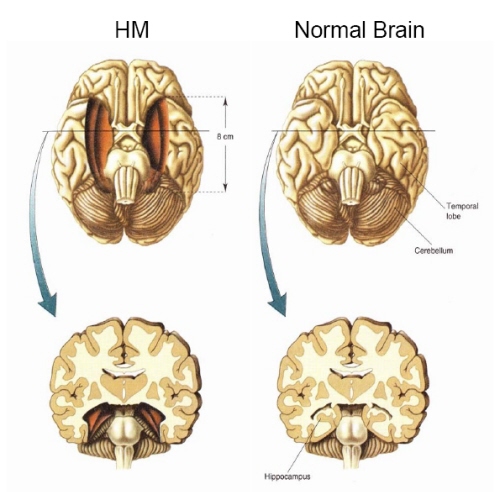
Bilateral destruction of the anterior hippocampus results in striking and profound disturbances involving memory and new learning (i.e. anterograde amnesia). For example, one such individual who underwent bilateral destruction of this nuclei (H.M.), was subsequently found to have almost completely lost the ability to recall anything experienced after surgery. If you introduced yourself to him, left the room, and then returned a few minutes later he would have no recall of having met or spoken to you. Dr. Brenda Milner has worked with H.M. for almost 20 years and yet she is an utter stranger to him.
H.M. is in fact so amnesic for everything that has occurred since his surgery (although memory for events prior to his surgery is comparatively exceedingly well preserved), that every time he rediscovers that his favorite uncle died (actually a few years before his surgery) he suffers the same grief as if he had just been informed for the first time.
H.M., although without memory for new (non-motor) information, has adequate intelligence, is painfully aware of his deficit and constantly apologizes for his problem. "Right now, I'm wondering" he once said, "Have I done or said anything amiss?" You see, at this moment everything looks clear to me, but what happened just before? That's what worries me. It's like waking from a dream. I just don't remember...Every day is alone in itself, whatever enjoyment I've had, and whatever sorrow I've had...I just don't remember" (Blakemore, 1977, p.96).
Presumably the hippocampus acts to protect memory and the encoding of new information during the storage and consolidation phase via the gating of afferent streams of information and the filtering/exclusion (or dampening) of irrelevant and interfering stimuli. When the hippocampus is damaged there results input overload, the neuroaxis is overwhelmed by neural noise, and the consolidation phase of memory is disrupted such that relevant information is not properly stored or even attented to. Consequently, the ability to form associations (e.g. between stimulus and response) or to alter preexisting schemas (such as occurs during learning) is attenuated (Douglas, 1967).
SHORT & LONG TERM MEMORY: THE ANTERIOR & POSTERIOR HIPPOCAMPUS
In humans, the hippocampus, the anterior and ventral hippocampus in particular, is usually associated with learning and memory of cognitively relevant information e.g. the long term storage and retrieval of newly learned information (Fedio & Van Buren, 1974; Milner, 1966; 1970; Penfield & Milner, 1958; Gloor, 1997; Rawlins, 1985; Scoville & Milner, 1957; Squire, 1992; see also commentary in Eichenbaum et al. 1994).
During learning activities LTP has been repeatedly found to occur within the hippocampus (Barnes & McNaughton, 1985; Enbert & Bonhoeffer, 1999; Lynch, 1986; Xu et al., 1998). Dendritic proliferation and the creation of specific neural circuits, as well as LTP, also occurs in the hippocampus during learning (Barnes, 1979; Enbert & Bonhoeffer, 1999; Lynch, 1986). It has also been demonstrated that hippocampal pyramidal cells undergo synaptic modification when flexible stimulus response associations are being formed (Enbert & Bonhoeffer, 1999; Rolls, 1987, 1988). Similar correlations between hippocampal LTP and learning have been found on tasks involving memory for visual-spatial relations (Barnes, 1979). Moreover, during acquisition, not only does LTP increase but so to does EEG evoked responses within the hippocampus (see Barnes & McNaughton, 1985).
Barnes and McNaughton (1985) found, however, that long-term hippocampus synaptic potentiation was more long lasting and more quickly reached by young than old animals. Older animals also demonstrated slower learning and faster rates of forgetting of spatial information.
Many of these synaptic and activational changes, in turn, are most apparent within the anterior regions of the hippocampus (Lynch, 1986) --which maintains rich interconnections with the amygdala (Amaral et al. 1992). Moreover, this same region of the hippocampus will become electrophysiologically potentiated during learning tasks. In fact, long term potentiation lasting up to several days have been noted in the hippocampus following successful learning trials (Lynch, 1986), which in turn may reflect the transition of information from short-term, to long term memory, at which point LTP ceases to be a factor in further memory maintenance.
These findings are consistent with the notion that the longer the potentiation, either at the cellular or hippocampal level, the stronger might be the memory, and the more likely it will persist over time. Hence, the formation of short-term memories appears to dependent on the anterior portion of the human hippocampus and the binding action of LTP which creates links between different synapses thus allowing for the transition from short to long term memory. It is noteworthy, however, that the amygdala appears to act on the anterior hippocampus in order to emotionally reinforce as well as modulate its functional activity (Gloor, 1992, 1997; Halgren, 1992), and LTP occurs in both nuclei.
[-INSERT FIGURE 8 ABOUT HERE-]
If the anterior hippocampus is injured or functionally suppressed, very little new cognitive learning occurs and potentiation does not appear. However, once these memories have been established in long term memory, the role of the anterior regions of the human hippocampus appears to diminish. This would explain why long term memory for long ago events is spared with hippocampal destruction.
Squire argues (1992, p. 222) that "the hippocampal formation is essential for memory storage for only a limited period of time. A temporary memory is established in the hippocampal formation at the time of learning in the form of a simple memory, a conjunction, or an index. The role of the hippocampus then gradually diminishes, and a more permanent memory is established elsewhere that is independent of the hippocampus...and... the neocortex alone gradually becomes capable of supporting usable, permanent memory. This reorganization could depend on the development of cortico-cortical connections between separate sites in neocortex, which together constitute the whole memory."
On the other hand, there is some human evidence which indicates that the more posterior human hippocampus may be responsible for long term memory access which is why retrograde amnesia has been reported with damage to or electrical stimulation of this area (Fedio & Van Buren, 1974; Penfield & Mathieson, 1974). Indeed, Penfield and Mathieson (1974) suggested that memories might actually migrate over time along the length of the hippocampus in a posterior direction, and that the ability to retrieve these memories follows this posterior movement.
THE HIPPOCAMPUS AND ASSOCIATED MEMORY STRUCTURES
Reverberating neurons are presumably located in various regions of the neocortex, and are apparently bound together via the simultaneous activity and steering influences involving the frontal lobes (Joseph, 1986a, 1999a), dorsal medial thalamus, and in particular the amygdala and hippocampus (Gloor, 1997; Graff-Radford, et al. 1990; Lynch, 1986; Rolls, 1992; Squire, 1992). These structures are all interlinked and highly involved in attention, arousal, and memory functioning, and probably act together so as to establish and maintain specific neural circuits and networks associated with specific memories (e.g., Brewer et al., 1998; Squire, et al,. 1992; Tulving et al., 1994; Wagner et al., 1998). For example, these different networks and neurons may be linked via the steering influences exerted by the frontal lobes etc., which can selectively activate or inhibit these memories and associated tissues in a coordinated fashion, and which can tie together certain perceptual experiences so as to form a complex multi-modal memory (e.g., Dolan et al., 1997; Joseph, 1982, 1986a, 1988a, 1999a; Kapur et al., 1995; Squire, et al,. 1992; Tulving et al., 1994; Dolan et al., 1997; Brewer et al., 1998; Wagner et al., 1998).
Likewise, since the hippocampus is a prime location for the development of LTP and is significantly involved in many aspects of memory functioning, it is presumably able to exert steering influences on different neocortical sites with which it is also richly, albeit indirectly interconnected via the entorhinal cortex. Via LTP (and the entorhinal cortex and dorsal medial nucleus) the hippocampus presumably acts to bind these divergent neocortical sites together so as to form a circuit of experience (Enbert & Bonhoeffer 1999; Lynch, 1986; Squire, 1992; Xu et al., 1998).
However, the human hippocampus (and overlying temporal lobe) also interacts with the amygdala and frontal lobes (Brewer et al., 1998; Squire, et al,. 1992; Tulving et al., 1994; Wagner et al., 1998), each of which also plays unique and overlapping roles in memory. Moreover, the hippocampus is important only in regard to certain aspects of memory, such as spatial, verbal, auditory, cognitive and recognition memory (Gloor, 1997; Nishitani, et al., 1999; Nunn et al., 1999; Xu et al., 1998), whereas the amygdala is concerned with emotional memory (Gloor, 1997; Halgren, 1992; LeDoux, 1996) and becomes activated by bizarre or traumatic stimuli, and when recalling trauma-memories (Rauch et al., 1996; Shin et al., 1997). By contrast, the frontal-thalamic system is more involved in retrieval and so called "working memory," as well as keeping something in mind so that it can be remembered and performed later (Brewer et al., 1998; Squire, et al,. 1992; Tulving et al., 1994; Wagner et al., 1998).
[-INSERT FIGURE 9 ABOUT HERE-]
Again, LTP is not an exclusive property of the hippocampus but also appears in entorhinal cortex, the frontal lobes, visual cortex, the motor areas of the frontal lobes (Artola & Singer, 1990; Chapman et al., 1990; Sutor & Hablitz, 1989) and the adjacent amygdaloid nucleus (Chapman et al., 1990) with which it is richly interconnected. Indeed, amygdaloid neurons show plasticity in response to learning (Lynch, 1986), and LTP has been induced in amygdala neurons (Chapman, et al. 1990). Fear induced neural plasticity in the form of LTP has been noted in amygdala neural pathways as well (Clugnet & LeDoux, 1990). This is presumably a consequence of the amygdala's involvement in most aspects of emotional experience, including the formation of cross-modal emotional associations and memories (Gloor, 1992, 1997; Halgren, 1992; Kesner, 1992; LeDoux, 1992, 1996; Rolls, 1992; however, see Murray & Gaffan 1994).
The amygdala is also intimately interlinked with the anterior hippocampus and appears to exert reinforcing and modulating influences on this nuclei (Gloor, 1997; Halgren, 1992). Moreover, they both project to adjacent thalamic relay neurons which raises the possibility they act conjointly to form separate but closely aligned neural networks concerned with different aspects of memory.
THE HIPPOCAMPUS AND ENTORHINAL CORTEX
The hippocampus does not receive direct neocortical input. Moreover, the data it does received, at least from the neocortex, originates in the association areas and is first transmitted to the entorhinal cortex or amygdala, and is then relayed to the hippocampus (see Horel et al. 1987; Issausti et al. 1987; Squire, 1992); the only apparent exception being auditory input which is transfered directly from the primary auditory areas to the entorhinal cortex. It is also via the overlying entorhinal area that the hippocampus receives amygdaloid projections (Carlsen et al., 1982; Gloor, 1955, 1997; Krettek & Price, 1976; Steward, 1977) and fibers from the orbital frontal and temporal lobes (Van Hoesen, et al., 1972). Thus, the hippocampus only receives neocortical input indirectly, and for the most part this is relayed by the entorhinal cortex--the "gateway to the hippocampus."
The entorhinal cortex is truly unique, not only because it serves as an interface between the hippocampus and the neocortex, but because this medial located structure consists of between 7 and 8 layers (Braak & Braak, 1992; Ramon y Cajal, 1902/1955; Rose, 1926). The entorhinal cortex also maintains massive interconnections with all multi-modal neocortical association areas (as well as with the amygdala, hippocampus, septal nuclei, olfactory bulb, etc.) but apparently none of the primary sensory areas (Leichnetz & Astruc, 1976; van Hoesen, et al., 1975). Hence, the entorhinal cortex must play a supramodal role that is exceedingly unique and profoundly important in memory and cognitive processing, and may play different roles, in for example, recognition vs recall vs short term and long-term memory.
[-INSERT FIGURE 10 ABOUT HERE-]
For example, some believe that the neocortex of the temporal lobe is the repository of those long term memories initially processed by the entorhinal cortex and hippocampus and that these latter structures are more important in recognition memory and act to store this material in the neocortex. Consider, for example, patients who undergo "hippocampal removals" whereas the overlying neocortex was spared (Milner, 1990) and patients such as the famous H.M., who underwent bilateral mesial temporal removals: amygdala, hippocampus, entorhinal cortex (Milner, 1968). These patients (particularly those with right sided destruction) perform exceedingly poorly on visual recognition memory tests, including those involving recurring nonsense figures (Kimura, 1963) and human faces (Milner, 1990).
Hence, recognition memory is disrupted with entorhinal and hippocampal removals. However, short term and immediate memory remains intact.
SHORT VS LONG TERM MEMORY LOSS, RETRIEVAL & HIPPOCAMPAL DAMAGE
When the hippocampus has been damaged the ability to convert short term memories into long term memories (i.e. anterograde amnesia), becomes significantly impaired in humans (Eichenbaum et al. 1994; Gloor, 1997; MacKinnon & Squire, 1989; Nunn, et al., 1999; Squire, 1992; Victor & Agamanolis, 1990) and primates (Zola-Morgan & Squire, 1984, 1985a, 1986). Lesions of the hippocampus can also disrupt time sense and temporal sequencing such as involving timing tasks (Meck et al. 1984). And, memory for words, passages, conversations, and written material is also significantly impacted, particularly with left hippocampal destruction (Frisk & Milner, 1990; Squire, 1992).
Moreover, spatial memory is significantly impaired among a variety of species with hippocampal lesions (Mishkin, et al. 1984; Nunn et al., 1999; Weiskrantz, 1987). In fact, the capacity to cognitively map, or visualize one's position and the position of other objects and individuals in visual-space is dependent on the hippocampus (Nadel, 1991; O'Keefe, 1976; Wilson and McNaughton, 1993). The hippocampus contains "place" neurons which are able to encode one's position and movements in space. Specifically, O'Keefe, Nadel, and colleagues, found that hippocampal pyramidal cells became sensitive to particular spatial coordinates and the location of objects in visual space, but that these spatial maps were also very plastic. These authors also found that as the subject moves about in that environment, entire populations of cells would fire but only when in a particular spot, whereas other cells would fire when in a different location. Moreover, some cells respond not just when moving about, but in reaction to the speed of movement, or when turning in different directions. Moreover, some cells are responsive to the movements of other people in that environment and will fire as that person is observed to move around. (Nadel, 1991; O'Keefe, 1976; Wilson and McNaughton, 1993).
[-INSERT FIGURE 11 ABOUT HERE-]
The hippocampus, therefore, can create a cognitive map of an individuals environment and their movements within it. Presumably it is via the hippocampus that an individual can visualize themselves as if looking at their body from afar, and can remember and thus see themselves engaged in certain actions, as if one were an outside witness (Joseph, 1998b, 1999d).
Therefore, patients with hippocampal destruction may demonstrate severe visual-spatial memory disturbances and may easily lose their way, forget where they place items, or where things are located (Nunn et al., 1999; Squire, 1992); particularly with right hippocampal injury. Nevertheless, initially individuals with even bilateral removal of the hippocampus demonstrate good initial retention and short-term memory (Horel, 1978; see commentary in Eichenbaum et al. 1994).
BILATERAL HIPPOCAMPAL DESTRUCTION & AMNESIA
Given the powerful effect of unilateral lesions on memory, bilateral destruction of the anterior hippocampus results in striking and profound disturbances involving almost all aspects of cognitive and recognition memory and new learning (i.e. anterograde amnesia), as well as retrograde amnesia (RA) for events that may extend 2-3 years in time (Marslen-Wilson & Teuber, 1975; Milner, 1966; Murray, 1992; Penfield & Milner, 1957; Scoville & Milner, 1956, Squire, 1992), particularly if the posterior hippocampus has also been injured or removed (Fedio & Van Buren, 1974). In the famous case of H.M. who underwent bilateral hippocampal and amygdala removals, retrograde amnesia was found to extend over 11 years (Corkin, 1984). However, as H.M. also had severe epilepsy, this extensive loss of pre-surgery memory may due to this preexisting lesion. For example, in other cases, patient have been able to describe and recall remote memories and are little different from normals in this regard (Horel, 1978; MacKinon & Squire, 1989; Squire, 1992). Nevertheless, there may be a permanent loss of memory extending backwards several years in time. A 37-year old Lt. Cornel who had sustained bilateral posterior temporal lobe and hippocampal destruction secondary to prolonged anoxia in 1969 (after being injured in Viet Nam), had no memory of his injury, and no memory of major events that had transpired two years prior to his injury. Although he could recall the death of President J.F. Kennedy, he could not recall the assassination of his brother, Robert Kennedy, though he could recall that Robert Kennedy had been attorney general and was running for president. As part of his "memory retraining" I had him read and reread short newspaper style articles including those describing the death of Robert Kennedy, and would then ask him questions about the story. Each time he read this latter article he had the same exact emotional and behavioral reaction, expressing surprise, shock, and sorrow, He had absolutely no memory of having read the same exact article just 30 minutes earlier--though he had answered all questions correctly immediately following each reading. Although I worked with him three times a week, for an hour a day, for over 3 months, he had absolutely no memory of who I was or of ever having met me.
In yet another case, an 18 year old boy who sustained bilateral inferior-anterior-medial temporal lobe and hippocampal destruction (following a car accident immediately after high school graduation), thought he was still sixteen an a "junior or a senior" in high school "I'm not sure." He also suffered a profound anterio-grade amnesia. His father described this boy's memory as "like a sieve. You fill it up with information and 30 minutes later its all leaked away. If you leave him alone for half an hour he will completely forget where he is, how he got there, and so on. Then he begins to panic for he forgets he was in a car accident and has lost his memory." In fact, while examining this boy he suddenly looked up at me in astonishment and had no idea who I was, where he was, why he was there, and so on. Nevertheless, in this particular boy's case, his anterograde memory loss was not global as he was capable of learning new motor routines and was able to get a job performing electronics assembly. However, he has also had to carry a note pad with "reminders" to tell him where he was, why he was there, etc.
Presumably, in part, loss of memory and the inability to acquire new memories following bilateral hippocampal injury is due to an inability to consolidate new information, such that short term memory remains intact whereas long-term memory is disrupted. In fact, with hippocampal injuries, the creation of LTP is disrupted (Lynch, 1986).
LEARNING AND MEMORY IN THE ABSENCE OF THE HIPPOCAMPUS
As noted, the 18-year old mentioned above was capable of learning simple motor tasks. Similarly, monkeys with hippocampal destruction, including those with bilateral destruction, although demonstrating severe memory impairments are capable of learning motor skill tasks and acquiring habits (Squire, 1992; Zola-Morgan & Squire, 1984, 1985a). Indeed, it has been repeatedly demonstrated that various aspects of learning and memory are retained in the absence of the hippocampus (see Eichenbaum et al. 1994; Horel, 1978; Seldon et al., 1991; Squire, 1992; Zola-Morgan, et al. 1986). This includes the learning of skilled and coordinated motor programs -as these "memories" appear to be dependent on the basal ganglia (Heindel et al. 1988; Packard, et al. 1989; Wang et al. 1990), cerebellum (Schmahmann, 1997; Thompson, 1986), inferior parietal lobule, the supplementary motor areas, and the lateral frontal motor areas (chapters 19, 20). The role of the hippocampus is minimal in these forms of learning (see Squire, 1992).
Classical conditioning is also independent of the hippocampus which may be a function of the repeated nature of stimulus presentation -the hippocampus soon ceases to respond in repetitive experiences (see chapter 30). In contrast, single learning associations are more dependent on the hippocampus (Squire, 1992).
The learning of emotional information also appears to occur independent of the hippocampus -being dependent on the amygdala (Gloor, 1997; LeDoux, 1996; Seldon et al., 1991). As noted, LTP has been induced in the amygdala and amygdala pathways (Chapman, et al. 1990; Clugnet & LeDoux, 1990), which is presumably a function of its involvement in most aspects of emotional memory formation (Gloor, 1997, Halgren, 1992; Kesner, 1992; LeDoux, 1996; Rolls, 1992), and the creation of emotional memory neuronal networks.
It has also been claimed that amnesics can aquire what Tulving (1972) calls semantic memory (a "mental thesaurus") which includes factual information and knowledge of words. However, the savings is so minimal as to be insignficant (Gabrieli et al., 1988). Hence, in general, hippocampal injury results in profound memory loss.
THE HIPPOCAMPUS AND DORSAL MEDIAL NUCLEUS
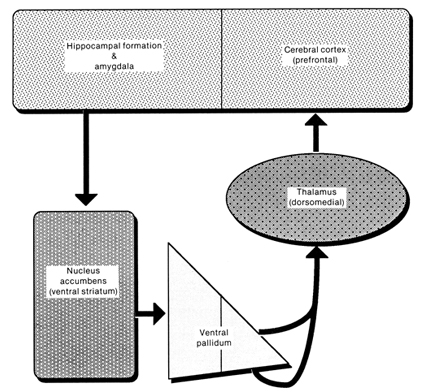
In addition, the hippocampus acts directly on the DMT, and on the orbital frontal lobes, and via the entorhinal cortex can act on the neocortex. In this manner the hippocampus can transmit to and keep track of where memories are stored, while simultaneously acting to store them in select neocortical regions. This is accomplished by simultaneously exerting influences on the DMT while sharing reciprocal influences with the orbital frontal lobe which also projects to the DMT.
Specifically, layer 2 of the hippocampus consists of pyramidal neurons which provide excitatory output and thus act to activate and arouse target tissues; via the transmitters glutamate and aspartic acid. In addition, the entorhinal cortex provides excitatory input into the hippocampus--input which is derived from the neocortex; using again, aspartic and glutamate acid (reviewed in Gloor, 1997). It thus appears that the hippocampus can interact with the neocortex is regard to arousal and memory storage via the dorsal medial nucleus of the thalamus and the entorhinal cortex, and can excite, for example, inhibitory circuits in the DMT (in conjunction with the frontal lobe) so as to direct neocortical activity, and perhaps coordinate this activity in regard to memory storage. In other words, these structures interact to insure that a certain neocortical area is selected for memory storage (via excitation), while simultaneously inhibiting and preventing information access in other areas. Memories can be stored and the hippocampus and frontal lobes, via the DMT, can keep track of where they are stored.
HIPPOCAMPUS & NEOCORTICAL AROUSAL
The frontal lobes, DMT, amygdala, hippocampus, entorhinal cortex, and the neocortex of the overlying temporal lobe all appear to interact in concert during various aspects of memory storage and retrieval as well as in the temporal placement of events in regard to time and even place (Brewer et al., 1998; Gloor, 1997; Graff-Radford et al. 1990; Talland, 1961; Wagner et al., 1998). This is why retrieval and even memory storage may become abnormal with damage to any of these nuclei.
There are reciprocal connections between the DMT and the amygdala, and temporal allocortex and mesocortex including the entorhinal cortex, as well as the lateral and orbital frontal lobes. This relationship suggests that the DMT upon receiving converging input, processes this material, and then at the behest of the frontal lobes, amygdala, and entorhinal cortex/hippocampus, stores this material in select areas of the neocortex such as the temporal lobe.
As discussed in chapter 13, the hippocampus exerts desynchronizing or synchronizing influences on various thalamic nuclei which in turn augments or decreases thalamic and neocortical activity (Green & Adey, 1956; Guillary, 1955; Nauta, 1956, 1958). As the thalamus is the major relay nucleus to the neocortex and is richly interconnected with the frontal lobes and amygdala, the hippocampus therefore appears able to act in concert with these nuclei so as to block or enhance information transfer to various neocortical areas where memories and perceptual experiences are presumably stored.
For example, when the neocortex becomes desynchronized (indicating cortical arousal), the hippocampus often (but not always) develops slow wave, synchronous theta activity (Grastyan et al. 1959; Green & Arduni, 1954) such that it appears to be functioning at a much lower level of arousal--at least in lower mammals. Conversely, when cortical arousal is reduced to a low level (indicated by EEG synchrony), the hippocampal EEG often becomes desynchronized and thus highly aroused (Grastyan et al., 1959; Green & Arduni, 1954). However, when this occurs, theta activity disappears and learning and memory are also disrupted--at least in lower mammals.
With the exception of the orbital frontal lobe, neocortical interconnections with the hippocampus are indirect and relayed by the entorhinal cortex,. Nevertheless, these interconnections (coupled with those of the DMT) enable the hippocampus to not only activate select regions--as its pyramidal projection system and that of the entorhinal cortex is excitatory (reviewed in Gloor, 1997)--but to sample information after it has been partially processed. This is accopmplished via the entorhinal cortex which projects back and forth from the association areas to the hippocampus. In this manner the hippocampus can also influence the processing that takes place via the DMT/Entorhinal cortex, and keep tract of what takes place as well.
The hippocampus consists of 3 layers, layer 2 consisting of pyramidal neurons which provide excitatory output. The hippocampus can act to activate and arouse target tissues; via the transmitters glutamate and aspartic acid. In addition, the entorhinal cortex provides excitatory input into the hippocampus--input which is derived from the neocortex; using again, aspartic and glutamate acid (reviewed in Gloor, 1997). The hippocampus can therefore exert significant activating influences on target tissues.
Specifically, it appears that the hippocampus interacts with the neocortex is regard to arousal via the orbital frontal lobe, dorsal medial nucleus of the thalamus, the septal nuclei, the hypothalamus, amygdala and brainstem--structures with which it maintains direct interconnections. As per the neocortex, this sheet of tissue is also innervated by these same limbic, thalamic, and brainstem structures, and by the entorhinal cortex.
Hence, the hippocampus serves as a major component of an excitatory interface and can be aroused by neocortical activity (via orbital frontal lobes, and aroused by the entorhinal cortex which provides excitatory input to the hippocampus). And the hippocampus can provide excitatory input directly to subcortical structures and indirectly to the neocortex (via the entorhinal cortex and dorsal medial nucleus) as well as directly influences the orbital frontal lobes and DMT.
Again, presumably these reciprocal interconnections may enable the hippocampus to keep track of this activity so as to form conjunctions between different brain regions which process associated memories (Rolls, 1990; Squire, 1992). By sampling the activity occurring in different regions and via its rich, indirect interconnections with these neocortical areas, the hippocampus (or entorhinal cortex) may also be able to determine which perceptions are the most relevant and which should be stored vs inhibited so that relevant memories need not compete with irrelevant sense data (Joseph, 1992a; Rolls, 1990a).
Presumably the hippocampus acts to aid in the creation of these networks and to thus protect memory and the encoding of new information during the storage and consolidation phase, by the gating of afferent streams of information and the filtering/exclusion (or dampening) of irrelevant and interfering stimuli; i.e. by reducing or increasing arousal in select regions and via inhibitory and excitatory influences on the DMT.
In consequence, if the hippocampus is damaged or is overwhelmed, there may be input overload, the neuroaxis may be also overwhelmed, and the consolidation phase of hippocampal memory formation is disrupted such that cognitively relevant information is not properly stored or even attended to (Joseph, 1998b, 1999d; Squire, 1992). Consequently, the ability to form non-emotional associations (e.g. between stimulus and response) and to create new neural networks, or to alter preexisting cognitive schemas and neural circuits is attenuated (Douglas, 1967). These individuals appear to be amnesic.
Again, however, this is a role the hippocampus also shares with the frontal lobes, which, in humans, is clearly dominant over the hippocampus in this regard. That is, the frontal lobes have taken over many functions that the hippocampus mediates in lower mammals.
EXCESSIVE HIPPOCAMPAL AROUSAL & MEMORY LOSS
As described in chapter 13, when lower mammals are exposed to novel stimuli or when engaged in active searching of the environment, hippocampal theta appears (Adey, et al. 1960) as does LTP (Lynch, 1986). There is thus a direct correlation between hippocampal theta and the development of hippocampal LTP (Lynch et al. 1990)--at least in lower mammals. However, with repeated presentations of a novel stimulus or when familiar stimuli are presented, the hippocampus habituates and theta disappears (Adey et al., 1960). Possibly, the reason the hippocampus and other brain structures appear to respond preferentially to novel stimuli and to then cease, at least during learning tasks, is because the continual processing of familiar stimuli in short-term memory is a waste of energy and attentional space.
As noted above, when the neocortex is highly stimulated, the hippocampus (in order to monitor what is being received and processed), functions at a lower arousal level in order not to become overwhelmed. However, at extremely high levels of arousal, what is being experienced may not be learned, or it will be learned independent of the hippocampus due to diminished hippocampal activity.
In situations where both the neocortex and the hippocampus become highly aroused and desynchronized, there results distractibility and hyperresponsiveness such that the subject becomes overwhelmed, confused, and may orient to and approach several stimuli (Grastyan et al., 1959); a condition that also occurs following hippocampal lesions (Clark & Issacson 1965; Douglas, 1967; Ellen et al. 1964)--at least in non-humans. Under conditions of abnormal or incoherent cortical arousal, the ability to think or respond coherently may be disrupted as is attention, learning, and memory functioning, i.e. memories are stored haphazardly, incompletely, or not at all.
Situations inducing high levels of arousal, perceptual disorganization, and memory loss sometimes also occur when individuals are highly anxious, frightened, or emotionally upset and traumatized (chapters 2, 30), e.g. during a prolonged and brutal rape or physical assault, or during horrendous battle field conditions -in which case hippocampal participation in memory formation dramatically decreases as neocortical and limbic arousal increases (Joseph, 1998b, 1999d). If the hippocampus is overwhelmed and deactivated, the victim will experience amnesia.
For example, in cases of transient global amnesia there is evidence for temporary mesial temporal inactivation (Hodges & Warlow, 1990), including bilateral hypofusion of the hippocamus (Evans et al., 1993). These structures also become inactivated following the seizure- or electrode induced- postictal anterograde amnesia (Brazier, 1966; Chapman et al. 1967; Halgren, et al., 1991). However, these memory deficits may shrink over time (Brazier, 1966; Squire 1992), as do those following mild or moderate head injuries up to the moment of impact.
Under emotionally traumatic or stressful conditions the hippocampus may also become highly and overactivated and it may in fact be injured (Lupien & McEwen, 1997; Sapolsky, 1996). Hence, it is not at all unusual for victims to profess a complete or partial amnesia for the event. However, because the amygdala may continue to function normally the victim may later experience flashbacks, heightened startle reactions, and intrusive emotional images (chapter 30). In these instances of extreme emotional stress, other brain structures, such as the amygdala probably play a more important role in memory and learning.
THE SEPTAL NUCLEI: HIPPOCAMPAL & SEPTAL INTERACTIONS
The septal nuclei consists of medial and lateral nuclei, and can be further subdivided into several nuclear components (Ariens Kappers et al., 1936; Swanson & Cowan, 1979), such as the nucleus of the diagonal band of Broca. The septal nuclei is an evolutionary derivative of the hippocampus and the hypothalamus, and in the human brain is richly interconnected with both structures including the amygdala, and the substantia innomminata (SI) which is a major memory center, and which manufactures ACh--a transmitter directly implicated in memory (Gage et al., 1983; Olton, 1990). Andy and Stephan (1968) and Swanson and Cowan (1979) considered the bed nucleus of the stria terminals (which gives rise to a major pathway linking the septal nuclei, and amygdala and hypothalamus) as part of the septal nuclei, whereas others (Gloor, 1997) consider it to be part of the "extended amygdala." Likewise, some consider the nucleus accumbens as part of the septal nuclei, and others consider it part of the "extended amygdala;" i.e. the limbic striatum.
As noted the septal nuclei is massively interconnected with the hippocampus as well as with the entorhinal cortex (Swanson & Cowan, 1979) via a number of pathways, including the fornix. Directly implicating the septal nuclei in the memory functioning of the hippocampus is the finding that septal activation of this structure results in ACh secretion (Gage et al., 1983), whereas septal grafts into the hippocampus improves learning and memory (Gage et al., 1986). Conversely, lesions of the fimbria-fornix septal-hippocampal pathway results ACh depletion throughout the hippocampus (Gage et al., 1983; Olton, 1990), as well as loss of norepinephrine and serotonin coupled with memory loss (Olton, 1990).
The septal nucleus in part regulate hippocampal memory-related activity not only by stimulating ACh and other neurotransmitter production (Gage et al., 1983, 1986), but as it provides excitatory input and inhibitory-GABAnergic-- especially from the medial septal nuclei which in general exerts inhibitory influences not only on the hippocampus but the amygdala and hypothalamus. In general, it is supposed that the excitatory-inhibitory influences on the hippocampus (like those on the amygdala and hypothalamus) serve to modulate activity and prevent extremes in arousal (Joseph, 1992a, 1998b, 1999d). This is accomplished in part not only through the interconnections maintained with the amygdala, hypothalamus and entorhinal cortex, but the brainstem reticular formation (Petsche et al., 1965)--with which the hippocampus is also connected directly and via the entorhinal cortex.
Septal influences on hippocampal/entorhinal arousal is also indicated by fluctuations in rhythmic slow activity (theta), which is generated by both the hippocampus and entorhinal cortex (Alonso & Garcia-Austt, 1987). As detailed in chapter 14, theta is an indication of hippocampal arousal (Green & Arduini, 1954; Petsche et al., 1965; Vanderwolf, 1992) and is associated with learning and memory (O'Keefe & Nadel, 1978). Theta is a robust electrophysiological phenomenon which has been found in the hippocampus of most species studied, including monkeys (Stewart & Fxx, 1990) and humans (Sano et al., 1970); though in primates it seems to differ from the theta rhythm of non-primates (see Gloor, 1997).
O'Keefe and Nadel (1978) believe that theta plays an important role in creating the spatial maps that are maintained by hippocampal "place" neurons; i.e. pyramidal neurons which are attuned to specific environmental features and landmarks and the animals place in that environment as they move about. Moreover, long term potentiation (LTP) which is associated with learning and memory, is generated in those neurons demonstrating theta or activity that is at the "theta frequency" (Staubli & Lynch, 1987).
Neurons of the septal nucleus which innervate the hippocampus fluctuate in activity in parallel with changes in the theta rhythm (Petsche et al., 1965), whereas septal lesions abolish hippocampal theta (Green & Arduini, 1954). It has long been believed that septal neurons act as an interface between the reticular formation and the hippocampus (Petsche et al., 1965) and in conjunction with its connections with the amygdala and hypothalamus, therefore modulate hippocampal arousal as well as learning and memory.
HIPPOCAMPAL & AMYGDALOID INTERACTIONS: MEMORY
It has been argued that significant impairments involving short-term memory and motor learning, cannot be produced by lesions supposedly restricted to the hippocampus (Horel, 1978; see also commentary in Eichenbaum et al. 1994); though in fact it is impossible to create such "restricted" lesions. Nevetheless, ignoring for the moment that inconvenient fact, in some instances with supposed restricted lesions, good recall of new information is possible for at least several minutes (Horel, 1978; Penfield & Milner, 1958; Squire 1992).
Moreover, there is considerable evidence which strongly suggests that the hippocampus plays an interdependent role with the amygdala in regard to memory (Gloor 1992, 1997; Halgren 1992; Kesner & Andrus, 1982; Mishkin, 1978; Murray 1992; Sarter & Markowitsch, 1985); particularly in that they are richly interconnected, merge at the uncus, and exert mutual excitatory influences on one another. For example, it appears that the amygdala is responsible for storing the emotional aspects and personal reactions to events in memory, whereas the hippocampus acts to store the cognitive, visual, and contextual variables (chapter 14) whereas that the amygdala activates the hippocampus by providing excitatory input (Gloor, 1955, 1997).
Specifically, the amygdala plays a particularly important role in memory and learning when activities are related to reward and emotional arousal (Gaffan 1992; Gloor 1992, 1997; Halgren 1992; LeDoux 1992, 1996; Kesner 1992; Rolls 1992; Sarter & Markowitsch, 1985). Thus, if some event is associated with positive or negative emotional states it is more likely to be learned and remembered.
The amygdala becomes particularly active when recalling personal and emotional memories (Halgren, 1992; Heath, 1964; Penfield & Perot, 1963), and in response to cognitive and context determined stimuli regardless of their specific emotional qualities (Halgren, 1992). However, once these emotional memories are formed, it sometimes requires the specific emotional or associated visual context to trigger their recall (Rolls, 1992; Halgren, 1992). If those cues are not provided or ceased to be available, the original memory may not be triggered and may appear to be forgotten or repressed. However, even emotional context can trigger memory (see also Halgren, 1992) in the absence of specific cognitive cues.
Similarly, it is also possible for emotional and non-emotional memories to be activated in the absence of active search and retrieval, and thus without hippocampal or frontal lobe participation. Recognition memory which may be triggered by contextual or emotional cues. Indeed, there are a small group of neurons in the amygdala, as well as a larger group in the inferior temporal lobe which are involved in recognition memory (Murray, 1992; Rolls, 1992). Because of amygdaloid sensitivity to visual and emotional cues, even long forgotten memories may be evoked via recognition, even when search and retrieval repeatedly fail to activate the relevant memory store.
According to Gloor (1992), "a perceptual experience similar to a previous one can through activation of the isocortical population involved in the original experience recreate the entire matrix which corresponds to it and call forth the memory of the original event and an appropriate affective response through the activation of amygdaloid neurons." This can occur "at a relatively non-cognitive (affective) level, and thus lead to full or partial recall of the original perceptual message associated with the appropriate affect."
In this regard, it appears that the amygdala is responsible for emotional memory formation whereas the hippocampus is concerned with storing verbal-visual-spatial and contextual details in memory. Thus, in rats and primates damage to the hippocampus can impair retention of context, and contextual fear conditioning, but it has no effect on the retention of the fear itself or the fear reaction to the original cue (Kim & Fanselow 1992; Phillips & LeDoux 1992, 1996; Rudy & Morledge 1994). In these instances, fear-memory is retained due to preservation of the amygdala. However, when both the amygdala and hippocampus are damaged, striking and profound disturbances in memory functioning result (Kesner & Andrus, 1982; Mishkin, 1978).
Therefore, the role of the amygdala in memory and learning seems to involve activities related to reward, orientation, and attention, as well as emotional arousal and social-emotional recognition (Gloor, 1992, 1997; Rolls, 1992; Sarter & Markowitsch, 1985). If some event is associated with positive or negative emotional states it is more likely to be learned and remembered. That is, reward increases the probability of attention being paid to a particular stimulus or consequence as a function of its association with reinforcement (Gaffan 1992; Douglas, 1967; Kesner & Andrus, 1982).
Moreover, the amygdala appears to reinforce and maintain hippocampal activity via the identification of motivationally significant information and the generation of pleasurable rewards (through action on the lateral hypothalamus). However, the amygdala and hippocampus act differentially in regard to the effects of positive vs. negative reinforcement on learning and memory, particularly when highly stressed or repetitively aroused in a negative fashion. For example, whereas the hippocampus produces theta in response to noxious stimuli the amygdala increases its activity following the reception of a reward (Norton, 1970).
LATERALITY.
It is now very well known that lesions involving the mesial-inferior temporal lobes (i.e. destruction or damage to the amygdala/hippocampus) of the left cerebral hemisphere typically produce significant disturbances involving verbal memory--particularly as constrasted with individuals with right sided destruction. Left sided damage disrupts the ability to recall simple sentences, complex verbal narrative passages, or to learn verbal paired-associates or a series of digits (Frisk & Milner 1990; Milner, 1966, 1970, 1971; Squire 1992).
In contract, right temporal destruction typically produces deficits involving visual memory, such as the learning and recall of geometic patterns, visual or tactile mazes, locations, objects, emotional sounds, or human faces (Corkin, 1965; Milner, 1965; Nunn et al., 1999; Kimura, 1963). Right sided damage also disrupts the ability to recognize (via recall) olfactory stimuli (Rausch et al. 1977), or recall emotional passages or personal memories (Cimino et al., 1991; Wechsler, 1973).
It appears, therefore, that the left amygdala and hippocampus are highly involved in processing and/or attending to verbal information, whereas the right amygdala/hippocampus is more involved in the learning, memory and recollection of non-verbal, visual-spatial, environmental, emotional, motivational, tactile, olfactory, and facial information. These issues and the differing roles of these nuclei in memory formation, as well as amnesia and repression will be discussed in greater detail in chapters 29, 30.
THE PRIMARY PROCESS AMYGDALA & PLEASURE
The amygdala maintains a functionally interdependent relationship with the hypothalamus in regard to emotional, sexual, autonomic, consumatory and motivational concerns. It is able to modulate and even control rudimentary emotional forces governed by the hypothalamic nucleus. However, the amygdala also acts at the behest of hypothalamically induced drives. For example, if certain nutritional requirements need to be meet, the hypothalamus signals the amygdala which then surveys the external environment for something good to eat (Joseph, 1982, 1992a). On the otherhard, if the amygdala via environmental surveilance were to discover a potentially threatening stimulus, it acts to excite and drive the hypothalamus as well as the basal ganglia so that the organism is mobilized to take appropriate action. When the hypothalamus is activated by the amygdala, instead of responding in an on/off manner, cellular activity continues for an appreciably longer time period (Dreifuss et. al., 1968). The amygdala can tap into the reservoir of emotional energy mediated by the hypothalamus so that certain ends may be attained (Joseph, 1982, 1992a)
AMYGDALA & HIPPOCAMPAL INTERACTIONS DURING INFANCY HALLUCINATIONS
The amygdal-hippocampal complex, particularly that of the right hemisphere, is very important in the production and recollection of non-linguistic and verbal-emotional images associated with past experience. In fact direct electrical stimulation of the temporal lobes, hippocampus and particularly the amygdala (Gloor, 1990, 1997) not only results in the recollection of images, but in the creation of fully formed visual and auditory hallucinations (Gloor 1992, 1997; Halgren 1992; Halgren et al., 1978; Horowitz et al., 1968; Malh et al., 1964; Penfield & Perot, 1963), as well as feelings of familiarity (e.g. deja vu).
Indeed, it has long been know that tumors invading specific regions of the brain can trigger the formation of hallucinations which range from the simple (flashing lights) to the complex. The most complex forms of hallucination, however, are associated with tumors within the most anterior portion of the temporal lobe (Critchley, 1939; Gibbs, 1951; Gloor 1992, 1997; Halgren 1992; Horowitz et al. 1968; Tarachow, 1941); i.e. the region containing the amygdala and anterior hippocampus.
Similarly, electrical stimulation of the anterior lateral temporal cortical surface results in visual hallucinations of people, objects, faces, and various sounds (Gloor 1992, 1997; Halgren 1992; Horowitz et al., 1968)--particularly the right temporal lobe (Halgren et al. 1978). Depth electrode stimulation and thus direct activation of the amygdala and/or hippocampus is especially effective.
For example, stimulation of the right amygdala produces complex visual hallucinations, body sensations, deja vus, illusions, as well as gustatory and alimentary experiences (Weingarten et al. 1977), whereas Freeman and Williams (1963) have reported that the surgical removal of the right amygdala in one patient abolished hallucinations.
Stimulation of the right hippocampus has also been associated with the production of memory- and dream-like hallucinations (Halgren et al. 1978; Horowitz et al. 1968).
The amygdala also becomes activated in response to bizarre stimuli (Halgren, 1992). Conversely, if activated to an abnormal degree, it may in turn produce bizarre memories and abnormal perceptual experiences. In fact, the amygdala contributes in large part to the production of very sexual as well as bizarre, unusual and fearful memories and mental phenomenon including dissociative states, feelings of depersonalization, and hallucinogenic and dream-like recollections (Bear, 1979; Gloor, 1986, 1992, 1997; Horowitz et al. 1968; Mesulam, 1981; Penfield & Perot, 1963; Weingarten et al. 1977; Williams, 1956).
In addition, sexual feelings and related activity and behavior are often evoked by amygdala stimulation and temporal lobe seizures (Halgren, 1992; Jacome, et al. 1980; Gloor, 1986, 1997; Remillard, et al. 1983; Robinson & Mishkin, 1968; Shealy & Peele, 1957), including memories of sexual intercourse (Gloor 1990) or severe emotional trauma and abuse (Gloor, 1997).
Moreover, intense activation of the temporal lobe and amygdala has been reported to give rise to a host of sexual, religious and spiritual experiences; and chronic hyperstimulation (i.e. seizure activity) can induce some individuals to become hyper-religious or visualize and experience ghosts, demons, angels, and even God, as well as claim demonic and angelic possession or the sensation of having left their body (Bear 1979; Gloor 1986, 1992; Horowitz, Adams & Rutkin 1968; MacLean 1990; Mesulam 1981; Penfield & Perot 1963; Schenk, & Bear 1981; Weingarten, et al. 1977; Williams 1956).
LSD.
As is well known, LSD can elicit profound hallucinations involving all spheres of experience. Following the administration of LSD high amplitude slow waves (theta) and bursts of paroxysmal spike discharges occurs in the hippocampus and amygdala (Chapman & Walter, 1965; Chapman et al. 1963), but with little cortical abnormal activity. In both humans and chimps, when the temporal lobes, amygdala and hippocampus are removed, LSD ceased to produce hallucinatory phenomena (Baldwin et al. 1959; Serafintides, 1965). Moreover, LSD induced hallucinations are significantly reduced when the right vs. left temporal lobe has been surgically ablated (Serafintides, 1965).
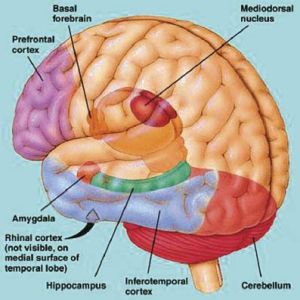
Overall, it appears that the amygdala, hippocampus, and the neocortex of the temporal lobe are highly interactionally involved in the production of hallucinatory experiences. Presumably, it is the neocortex of the temporal lobe which acts to interpret this material (Penfield & Perot, 1963) as perceptual phenomena. Indeed, it is the interrelated activity of the temporal lobes, hippocampus and amygdala which not only produce memories and hallucinations, but dreams. In fact, the amygdalas involvement in all aspects of emotion and sexual functioning, including associated memories, the production of overwhelming fear as well as bizarre and dream-like mental phenomenon, may well account for why this type of unusual stimuli, including personal and innocuous memories also appears in dreams.
DREAMING
When hallucinations follow depth electrode or cortical stimulation, much of the material experienced is very dream-like (Gloor 1990, 1992; Halgren et al., 1978; Malh et al., 1964; Penfield & Perot 1963) and consists of recent perceptions, ideas, feelings, and other emotions which are similarly illusionary and dream-like. Indeed, the right amygdala, hippocampus, and the right hemisphere in general (Broughton, 1982; Goldstein et al., 1972; Hodoba, 1986; Humphrey & Zangwill, 1961; Kerr & Foulkes, 1978; Meyer et al. 1987) also appear to be involved in the production of deam imagery as well as REM sleep (chapter 10).
For example stimulation of the amygdala triggers and increases ponto-geniculo-occipital paradoxical activity during sleep (Calvo, et al. 1987), which in turn is associated with REM and dreaming. In addition, during REM, the hippocampus begins to produce slow wave, theta activity (Jouvet, 1967; Olmstead, Best, & Mays, 1973; Robinson et al. 1977), which is associated with long-term potentiation which is associated with learning and memory (see chapter 14).
Presumably, during REM, the hippocampus and amygdala act as a reservoir from which various images, emotions, words, and ideas are drawn and incorporated into the matrix of dream-like activity being woven by the right hemisphere. It is probably just as likely that the right hippocampus and amygdala serve as a source from which material is drawn during the course of a daydream.
The Right Hemisphere & Dreams.
There have been reports of patients with right cerebral damage, hypoplasia and abnormalities in the corpus callosum who have ceased dreaming altogether, suffer a loss of hypnogic imagery or tend to dream only in words (Botez et al. 1985; Humphrey & Zangwill, 1951; Kerr & Foulkes, 1981; Murri et al. 1984). However, there have also been some report that when the left hemisphere has been damaged, particularly the posterior portions (i.e. aphasic patients), the ability to verbally report and recall dreams also is greatly attenuated (e.g., Murri et al. 1984). Of course, aphasics have difficulty describing much of anything, let alone their dreams.
Electrophysiologically the right hemisphere also becomes highly active during REM, whereas, conversely, the left brain becomes more active during N-REM (Goldstein et al. 1972; Hodoba, 1986). Similarly, measurements of cerebral blood flow have shown an increase in the right temporal regions during REM sleep and in subjects who upon wakening report visual, hypnagogic, hallucinatory and auditory dreaming (Meyer et al. 1987). Interestingly, abnormal and enhanced activity in the right temporal and temporal-occipital area acts to increase dreaming and REM sleep for an atypically long time period (Hodoba, 1986). Hence, it appears that there is a specific complementary relationship between REM sleep and right temporal electrophysiological activity.
Interestingly, daydreams appear to follow the same 90-120 minute cycle that characterize the fluctuation between REM and NREM periods, as well as fluctuations in mental capabilities associated with the right and left hemisphere (Broughton, 1982; Kripke & Sonneschein 1973). That is, the cerebral hemisphere tend to oscillate in activity every 90-120 minutes -- a cycle which appears to correspond to the REM-NREM cycle and the appearance of day and night dreams. Forgotten Dreams.
Most individuals, however, have difficulty recalling their dreams. This may seem paradoxical considering that hippocampal theta is being produced. However, this is theta punctuated by high levels of desychronized activity, which is not conducive to learning. In this regard, theta activity may represent the reverberating activity of neural circuits formed during the day, such that the residue of day time memories come to be inserted into the dream. Conversely, due to the high level of desychronization occuring in the hippocampus (as it is so highly aroused), although it contributes images and the days memories, it does not participate in storing these dream-like experiences into memory.
Consider the results from temporal lobe, amygdala, and hippocampal electrical stimulation on memory recall and the production of hallucinations. Although personal memories are often activated at low intensities of stimulation (memories which are verified not only by the patient but family), if stimulation is sufficiently intense, the memory instead will become dreamlike and populated by hallucinated and cartoon like characters (Halgren, et al. 1978). That is, at low levels of stimulation memories are triggered but these memories become increasingly dream-like with high levels of activity. Moreover, once these high levels of stimulation are terminated, patients soon become verbally amnesic and fail to verbally recall having had these experiences (Gloor, 1992; Horowitz, et al. 1968).
However, these memories can be later recalled if subjects are provided with specific contextual cues (Horowitz, et al. 1968). The same can occur during the course of the day when a fragment of a conversation, or some other experience, suddenly triggers the recall of a dream from the previous night which had otherwise been completely forgotten. Presumably it had seemingly been forgotten because the hippocampus did not participate in their storage and thus could not assist in their retrieval (see chapters 29, 20).
There is also some evidence to suggest that different regions of the hippocampus show different levels of arousal during paradoxical sleep. For example, it appears that the posterior hippocampus becomes activated during paradoxical sleep and shows theta activity, whereas the more anterior portions become inhibited (Olmstead et al. 1973). As the anterior portions are more involved in new learning (at least in humans), whereas the posterior hippocampus is more concerned with old and well established memories, this would suggest that the posterior hippocampus is contributing older or already established memories to the content of the dream--which explains why theta, which is associated with learning and memory, is also produced during the dream--that is, it is replaying various fragmentary memories. Conversely, the inhibition of the anterior region would prevent this dream material from becoming rememorized.
DREAMS & INFANCY
In the newborn, and up until approximately 6-9 months, there are two distinct stages of sleep which correspond to REM and N-REM periods demonstrated by adults (Berg & Berg, 1978; Dreyfus-Brisac & Monod, 1975; Parmelee et al. 1967). Among infants, however, REM occur during wakefullness as well as during sleep. In fact, REM can be observed when the eyes are open, when the infant is crying, fussing, eating, or sucking (Emde & Metcalf, 1970). Moreover, REM is also observed to occur within a few moments after an infant begins to engage in nutritional sucking and appears identical to that which occurs during sleep (Emde & Metcalf, 1970).
The production of REM during waking in some respects seems paradoxical. Nevertheless, it might be safe to assume that like an adult, when the infant is in REM, he or she is dreaming, or at least, in a dream-like state. Possibly, this state corresponds to what Freud has described as the Primary Process. That is, when produced when the infant is crying or fussing, it is dreaming of whatever relief it seeks. Correspondingly, REM which occurs while eating or sucking may have to do with the limbic structures which are involved not only in the production of dream-like activity, but the identification, learning and retention of motivationally significant information (i.e. the amygdala and hippocampus).
Presumably this relationship is a consequence of REM as well as eating and sucking being mediated, in part, by the amygdala as well as other limbic nuclei, which are also concerned with forming motivationally significant memories. Hence, when hungry, the hypothalamus becomes aroused which activates the amygdala which is responsible for the performing environmental surveillance so as to attend, orient to, identify and approach motivationally significant stimuli and eat. However, because the infants brain is so immature and as its resources for meeting its limbic needs are quite rudimentary, under certain conditions prolonged hypothalamus induced amygdala activation results in the formation and recall of relevant memories which may be experienced as hallucinations of the desired object. That is, previously formed neural networks become activated and the infant begins to dream and hallucinate food and will then suck and smack its lips as if eating or sucking when it is awake, in REM, and there is no food present.
THE PRIMARY PROCESS
The hypothalamus, our exceedingly ancient and primitive Id, has an eye that only sees inward. It can tell if the body needs nourishment but cannot determine what might be good to eat. It can feel thirst, but has no way of slacking this desire. The hypothalamus can only say: "I want", "I need", and can only signal pleasure and displeasure. However, being the seat of pleasure, the hypothalamus can be exceedingly gracious in rewarding the organism when its needs are met. Conversely, when its needs go unmet it can respond not only with displeasure and feelings of aversion, but with undirected fury and rage. It can cause the organism to cry out.
Nevertheless, the cry does not produce the immediately desire relief or reduction in tension. There is thus a pressure on the limbic system and the organism to engage in environmental surveillance so as to meet the needs monitored by the hypothalamus.
Over the course of the first months of life, as the amygdala and then hippocampus develop, the organism begins to develop an eye that not only sees outward, but which can register and recall events, objects, people, etc., associated with tension reduction, pleasure and the satiaty of the infants internal needs (e.g. the taste, smell, feeling of mother's breast and milk, the experience of sucking and relief, etc.). This is called learning.
With the maturation of these two limbic nuclei the infant is increasingly able to differentiate what occurs in the external environment based on hypothalamically monitored needs and the emotional/motivational significance of that which is experienced. The infant can now orient, selectively attend, determine what brings satisfaction, and store this information in memory.
PRIMARY IMAGERY
Although admittedly we have no direct knowledge as to the psychic interactions in the neonate, it does seem reasonable to assume that as the neocortex and underlying structures and fiber pathways mature, neural "prgorams" are formed which correspond to the repeated registration of experiences which are deemed significant (e.g. pleasurable). That is, neural pathways which are repetitively fired, deactivated or activated in response to specific sensory and affective activities and experiences, become associated with that activity, such that an associated neural circuit is formed (chapter 14); i.e. a memory is created. Eventually, if this circuit is reactivated, the "learned" pattern is reexperienced; i.e. the organism remembers.
Thus, infants as young as 2 days of age can learn to suck at the mere sight of a bottle (see Piaget, 1954) and in order to receive milk as a reinforcement, infants can even modify their sucking response (Sameroff & Cameron, 1979). Hence, they are suceptible to classical conditioning (Sameroff & Cavanagh, 1979), although the possibility of operant conditioning has not been established. Nevertheless, the fact that they can recognize the bottle and suck (as well as cry and shed tears) indicates that various regions of the limbic system, especially that of the amygdala is functional and that learning and the creation of specific, context specific neural circuits have been formed very early in life.
Thus, when the amygdala/hippocampus are stimulated by a hungry hypothalamus, the events and images associated with past experiences of pleasure can not only be searched out externally, but recalled in imaginal form. For example, as an infant experiences hunger and stomach contractions as well as it own cries of displeasure, these states become associated with the sound, smell, taste, etc. of mother and her associated movement and other stimuli which accompany being fed (cf Piaget, 1952, pp. 37, 407-408). Repetitively experienced, the sequence from hunger to satiety evokes and becomes associated with the activation of certain neural pathways and the creation of a specific neural network subserving that memory (chapter 14).
Eventually, when the infant becomes hungry, if prolonged there is the possibility that the entire neural sequence associated with hunger and feeding (i.e. hunger, mother, food, satiaty), may become involuntarily triggered and activated (via association) such that an "image" of being fed is experienced. The activation of these rudimentary and infantile memory-images is probably what consititutes, at least in part, the primary process.
Behaviorally this is manifested by REM and via sucking and tongue movements as if eating, when in fact there is no food present (cf, Piaget, 1952). That is, when hungry, the infant will begin to cry, rapid eye movement (REM) might be observed, and then the infant will stop crying and smack its lips and make sucking movement (mediated by the amygdala) as if it were being fed. The infant experiences the experience of being fed in the form of a dream (Joseph, 1982) or hallucination, although it is awake.
In that the brain of the human infant is quite immature for in fact several years, which in turn restricts information reception and processing (chapters 23-28), and given the limited amount of reality contact infants are able to achieve, these rudimentary memories and images (even when occurring during waking, i.e. REM), are probably indistinguishable from actual experience simply because they are experience.
Like a dream, when replayed, the infant presumaly reexperiences to some degree the sensations, emotions, etc., originally linked to tension reduction. Thus, the young infant, as yet unable to distinguish between representation and reality, responds to the image as reality (Freud, 1900, 1911), even while awake--as manifested by REM. When hunger is prolonged the association linked to feeding are triggered and for a brief time period the infant behaves as if its hunger has been sated. Reality is replaced by an image, or rather, a "dream". This is the primary process.
Since the hypothalamus (which monitors internal homeostasis) is not conscious that the dream images experienced are not real, it initially accepts the memory/dream images transmitted from the amygdala and hippocampus and ceases to cry, i.e. it responds to the imagined sources of nourishment just as it responds to a cue-tone associated with a food reward (Nakamuar & Ono, 1986; Ono et al., 1980). However, the hypothalamus is not long fooled, for the primary process does not offer effective long lasting relief from tension. As the pain of hunger remains and increases, limbic activity is increased, and the image falls away to be replaced by a cry of hunger (Joseph, 1982). The amygdala and hippocampus are thus forced to renew their surveillance of the environment in search of sources of tension reduction. Cognitive development is thus promoted.
LIMBIC OVERVIEW
THE HYPOTHALAMUS
THE AMYGDALA
THE HIPPPOCAMPUS
NeuroTheology
Click Here to Purchase
From Amazon.com
Transmitter to God
Click Here to Purchase
From Amazon.com
<
BrainMind.com - Contents
Copyright © 2000-2006 All Rights Reserved