Jesus Christ
The Passion
The Crucifixion
by Rhawn Joseph, Ph.D.
To be scourged and then crucified was to be condemend to a horrible and prolonged death in which the victim might suffer in agony for several days before finally dying.
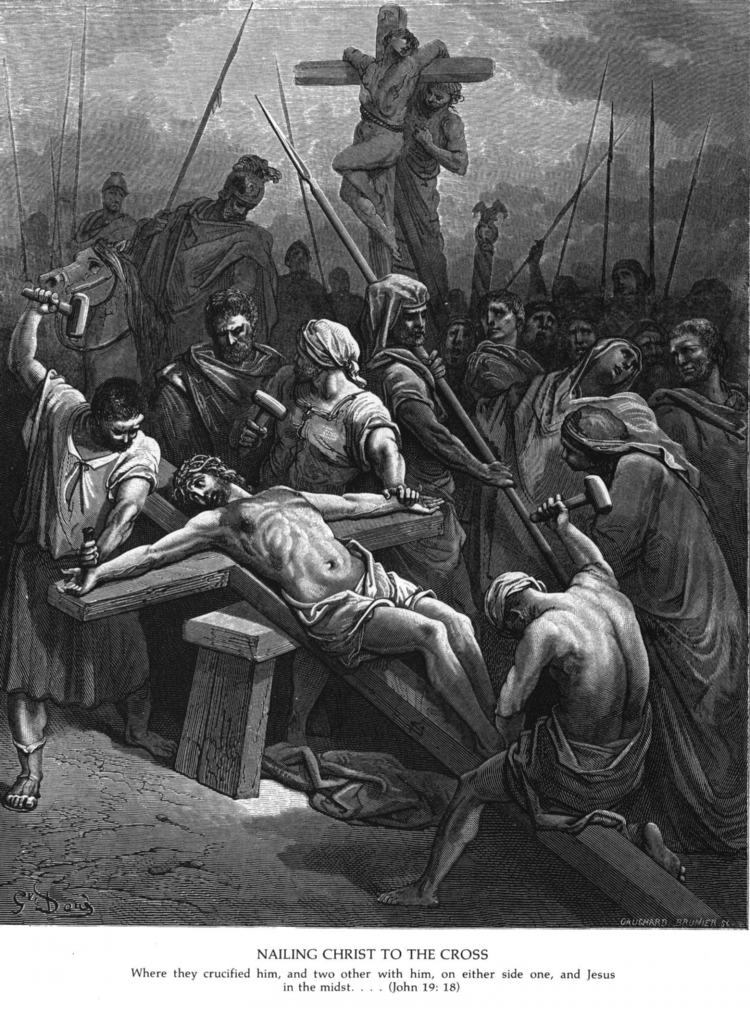
Initially, the victim would be whipped until the skin peeled away and blood gushed from his wounds. His arms would be stretched lengthway, sometimes behind his back and neck, and his hands and wrists would be nailed to a heavy cross beam. The victim, now attached to the cross, would then be lifted upright. Often the feet would also be nailed to the cross so as to prolong the agony. If he were left to dangle by his hands, without any support, there would be so much pressure and compression on his chest, he would have difficulty taking a breath and might suffocate.
The nailing of the feet was the more prolonged form of crucifixion. If his feet were also nailed to the beam, the victim would be able to "stand" upright, thus taking some of the incredible pressure off his arms and chest, though he would still be in considerable agony. Victims crucified in this fashion, could take several days to die, as was the case, with the two thieves who hung from their crosses and were still alive after Jesus had been pronounced dead.
However, if the victim looked as if he might immediately die, thus cheating the Romans out of their full measure of punishment, he might be given vinegar to drink. Vinegar has a stimulating effect, arousing the victim to wakefulness, which is why those to be crucified were usually given vinegar before and after they were nailed to the cross.
In some cases, after the victim had hung from the cross for several days, the Romans might break their legs, as a show of mercy, thus sending them into shock, and a quick death. They would then be impaled, with a spear, to allow blood and fluid to slowly drain from the body. The body would then mummify as it remained hanging from the cross, sometimes for weeks: Crucifixion was not just punishment, but served as a warning to all who dared break Roman law.
Jesus was to be nailed, hand and foot, to the cross. His was to be the most horrendous form of crucifixion.
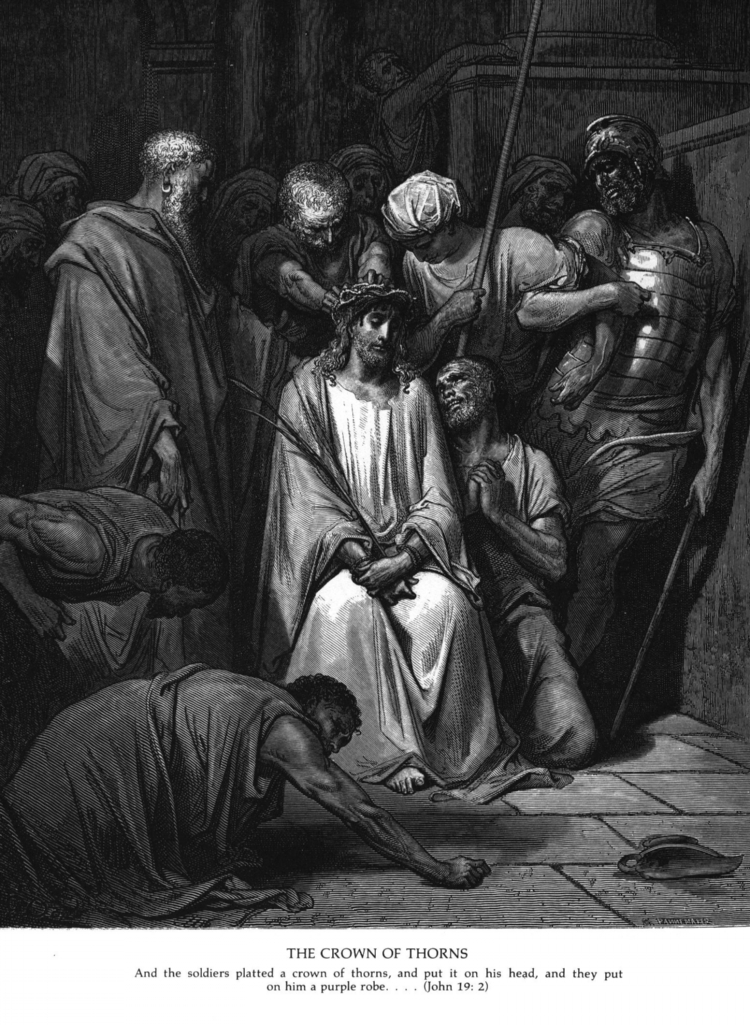
"Then the soldiers of the governor took Jesus into the common hall, and gathered unto him the whole band of soldiers. And they stripped him, and put on him a scarlet robe. And when they had platted a crown of thorns, they put it upon his head, and a reed in his right hand: and they bowed the knee before him, and mocked him, saying, Hail, King of the Jews! And they spit upon him, and took the reed, and smote him on the head. And after that they had mocked him, they took the robe off from him, and put his own raiment on him, and led him away to crucify him."
"Then said Jesus, Father, forgive them; for they know not what they do. And they parted his raiment, and cast lots."
"And when they were come unto a place called Golgotha, that is to say, a place of a skull, They gave him vinegar to drink mingled with gall: and when he had tasted thereof, he would not drink."
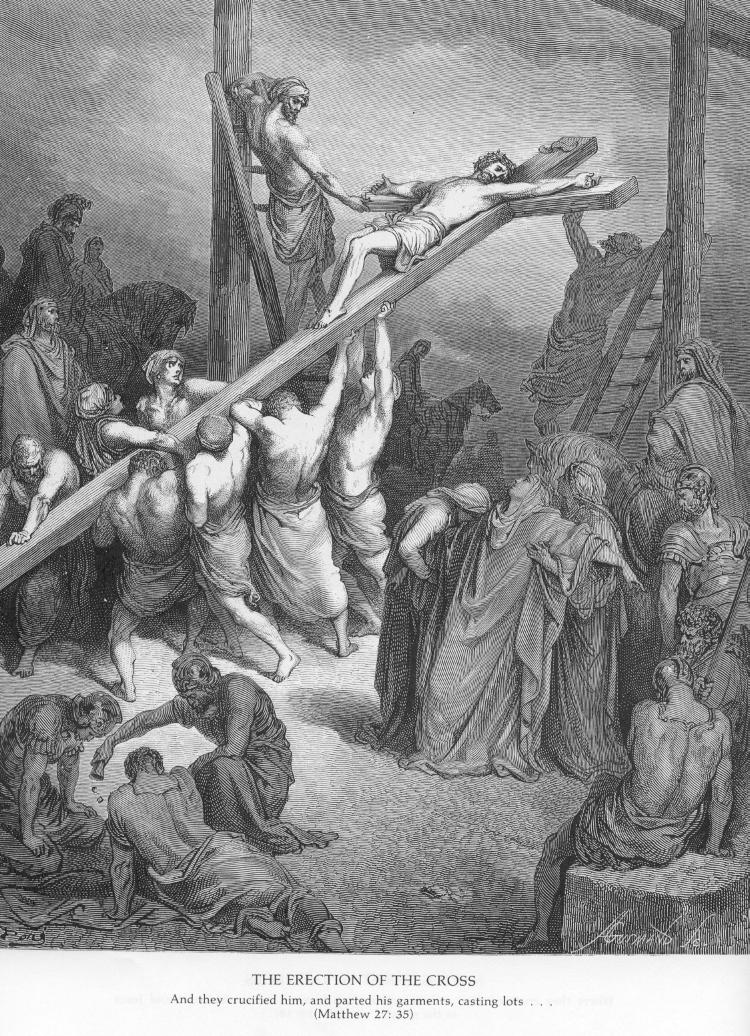
"And they crucified him, and parted his garments, casting lots: that it might be fulfilled which was spoken by the prophet, They parted my garments among them, and upon my vesture did they cast lots. And sitting down they watched him there; And set up over his head his accusation written, THIS IS JESUS THE KING OF THE JEWS."
"And they that passed by reviled him saying, save thyself. If thou be the Son of God, come down from the cross. Likewise also the chief priests mocking him, with the scribes and elders, said, He saved others; himself he cannot save. If he be the King of Israel, let him now come down from the cross, and we will believe him. He trusted in God; let him deliver him now, if he will have him: for he said, I am the Son of God."
"Then were there two thieves crucified with him, one on the right hand, and another on the left. And one of the malefactors which were hanged railed on him, saying, If thou be Christ, save thyself and us. But the other answering rebuked him, saying, Dost not thou fear God." - Luke 23
"Now there stood by the cross of Jesus his mother, and his mother's sister, Mary the wife of Cleophas, and Mary Magdalene. When Jesus therefore saw his mother, and the disciple standing by, whom he loved, he saith unto his mother, Woman, behold thy son! Then saith he to the disciple, Behold thy mother! And from that hour that disciple took her unto his own home."
Jesus hung, nailed to the cross for the next 3 to 6 hours. Everything, so far, had taken place according to prophecy, and exactly as Jesus had predicted and planned. He had been rejected by the people, betrayed into the hands of the chief priests, and had been crucified by the Gentiles.
Now the next phase of the plan would begin to unfold: His death and ressurrection.
As Jesus knew, because it was the Passover, and the eve ("preparation") of the sabbath day, his "dead" body, "should not remain upon the cross on the sabbath day" (John 19). However, as Jesus also knew, because it was the eve of the Sabbath, and in order to not offend Jewish sensitivities, if he was still alive that evening, the Romans would break his legs, thus giving him the coup de gras, and thus killing him so his dead body could be taken down from the cross.
It was thus important that Jesus should die, on the cross, without any assistance from the Romans, that same day.
Jesus may have been counting on his secret disciples to help make this a reality.
Jesus had other secret disciples, who, like the "disciple whom he loved," stood at the foot of the cross. These included "a rich man of Arimathaea, named Joseph, who also himself was Jesus' disciple," as well as a friend and "an honourable counsellor" of Pilate's court (Mark 15; Matthew 21). When Jesus sleepth unto death, it would be Joseph of Arimathaea, who would ask Pilate for permission to remove the body, and place it "in his own new tomb, which he had hewn out in the rock" (Matthew 21).
And, according to prophecy, like Lazarus, Jesus would awaken and live again. To the astonishment of the Pharisees, the chief priests, the scribes, and the Gentiles, he would rise "on the third day," and then the Messiah, Jesus the Christ, the King of the Israel, would usher in the Era of Righteousness, in which all people and all the nations of the world would live in harmony and without war or sin. Universal justice would prevail and the ideal of the Brotherhood of Man would become a reality. The Messiah, Jesus Christ, this man whose message was peace and love, would seal God's New Convenant and would rule the world. War, poverity, and injustice, would be no more.
Jesus hung, nailed to the cross for 6 to 9 hours. He was in horrible agony. A crowd of men stood at the foot of the cross, many of them laughing and mocking him. Others, such as Joseph of Arimathaea, presumably stood, waited and watched, saying nothing.
After the 9th hour, and the fall of darkness, Jesus suddenly "cried with a loud voice, saying, My God, my God, why hast thou forsaken me?"
Now a curious thing occurred. "And some of them that stood by, when they heard it, said, Behold, he calleth Elias. And one ran and filled a spunge full of vinegar, and put it on a reed, and gave him to drink, saying, Let alone; let us see whether Elias will come to take him down" -Mark 15.
Vinegar, we know, acts as a stimulant. Twice, already, Jesus had refused to drink. The first instance was when he was being led to his crucifixion: "They gave him vinegar to drink mingled with gall: and when he had tasted thereof, he would not drink." Then again, after he had been hung on the cross, "the soldiers mocked him, offering him vinegar" (Luke 23:36), yet, again, he did not drink.
However, after the 9th hour, when Jesus cried out: "Eloi, Eloi, lama sabachthani?" ("My God, my God, why hast thou forsaken me"), as if on cue, one of the men ran, and took a spunge, and filled it with what we have been told is "vinegar," and put it on a reed, and gave him to drink. And yet, although vinegar should have aroused Jesus to full wakefullness, exactly the opposite happened.
"And Jesus cried with a loud voice, and gave up the ghost."
Jesus Christ was dead. They had crucified him.
|