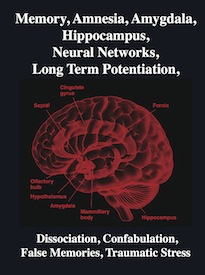
Neocortex Calls Upon the Hippocampus, To Retrieve Memories, During Sleep, November 10, 2006
Their work, shows that during dream sleep, instead of the hippocampus uploading information to the neocortex in a burst of brain cell communication, Mehta found the opposite: the neocortex seems to drive the dialogue with the hippocampus.
To study this dialogue, Mehta recorded electrical activity in rat brains. To mimic the deepest sleep states, the rats were anesthetized then fitted with two electrodes. One electrode measured the electrical activity of thousands of cells in the neocortex. These cells were excitatory, meaning that they spark communication between nerve cells. The other electrode recorded the activity of a single inhibitory cell in the hippocampus. These inhibitory cells shut down dialogue between nerve cells.
Using this groundbreaking single-cell recording technique, honed in Sakmann’s laboratory at the Max Planck Institute for Medical Research, researchers made an important finding: During deepest sleep, in both the hippocampus and neocortex, the patterns of neural activity are both regular and highly related. The cells in the old and new brains fired nearly in synch, evidenced by similar peaks and troughs shown on electroencephalographs.
Previous studies have shown that during deep sleep, when the excitatory cells in the neocortex showed rhythmic activity, excitatory neurons in the hippocampus showed erratic activity. This stumped Mehta and his colleagues: If these two parts of the brain talk during deep sleep, why didn’t they appear to be speaking the same language? They are, Mehta and his team discovered, if you listen to inhibitory, not excitatory, cells in the hippocampus. Mehta and his team also showed that the activity of the cells is related. The timing of activity, or talk, was the same in both brain regions, with a small delay in the hippocampus – as if those cells were echoing the speech in the neocortex.
This discovery of synchronized communication between the old and the new brain – a phenomenon known as “phase-locking” – has two key implications. It suggests that the neocortex, not the hippocampus, drives the discussion between these brain systems during deep sleep. It also suggests that the inhibitory neurons control the conversation.
Mehta says the findings may change the way neuroscientists look at past experimental data and the way they conduct future research.
“We now have a way, experimentally and theoretically, to see how the two parts of the brain talk to each other,” he said. “This will help us better understand the mechanisms behind learning and memory. But what is really exciting is that this method – simultaneously studying two different cell types in two different brain areas – could be used to study other aspects of brain function, such as perception, emotion, movement. It could open important new avenues for basic and applied research.”